If you have a marine aquarium, sooner or later you’ll ask yourself: do I need a controller?
The answer is almost always yes. Monitoring temperature, pH, dosing additives, managing automatic top-off, and receiving phone notifications is no longer a luxury — it’s become essential for maintaining a stable reef.
But which controller should you choose? In 2026 the options run from thousand-dollar professional systems to open source projects, with do-it-yourself in between. This article compares the main alternatives so you can work out which one fits you.
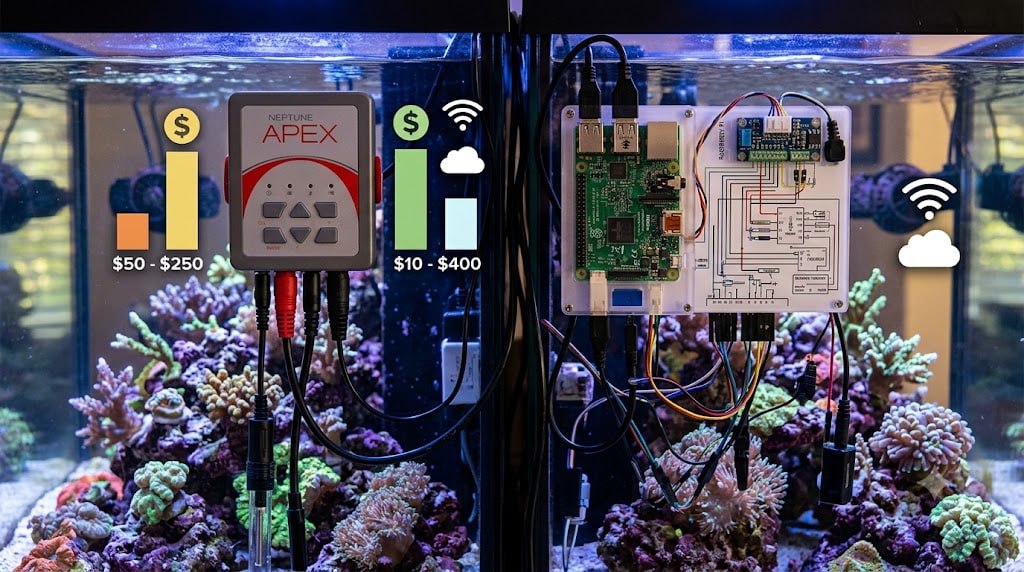
The contenders
One clarification, otherwise the comparison isn’t honest: the commercial controllers in this table arrive assembled, tested and warrantied, with support behind them and a dealer to turn to when something goes wrong. That price covers all of it, and for plenty of people it’s money well spent.
JoyReef and Reef-Pi cost less because you build the controller yourself. The saving is real, but you pay for it in time, in a few wiring mistakes, and in the fact that if it fails at two in the morning there’s no number to call. This table is here to help you work out which box you’re in, not to crown a winner.
| System | Type | List price | Level |
|---|---|---|---|
| Neptune Apex (A3) | Professional | $791.99 (Apex) – $1,169.99 (Apex Pro) | Advanced |
| GHL ProfiLux 4 | Professional | €549.90 (incl. 19% VAT) | Advanced |
| HYDROS Control X4 (CoralVue) | Semi-pro | $434.27 (controller only) | Intermediate |
| Red Sea ReefControl (new in 2026) | Commercial | $329.00 (Lite) – $429.00 (Pro) | Intermediate |
| Reef-Pi | Open source | ~$70 – $340 in parts | Technical |
| JoyReef (doser) | DIY+Cloud | €120 – €255 in parts | All |
| JoyReef (ATO) | DIY+Cloud | ~€30 in parts | All |
Prices verified on 12 August 2026 on manufacturers’ official sites or, where noted, authorised resellers: Neptune Systems, GHL, Premium Aquatics (HYDROS), SaltwaterAquarium (Red Sea). Neptune, HYDROS and Red Sea list in US dollars for the US market; GHL lists in euros including 19% German VAT. Shelf prices in Europe can be significantly higher for the US brands, due to import, distribution and VAT. The JoyReef and Reef-Pi figures are not list prices: they are component costs, which vary with supplier and with what you choose to build.
🔬 Neptune Apex — the benchmark
Neptune Systems’ Apex is considered the industry standard. The A3 series covers temperature, pH, ORP and conductivity, controls up to 16 outlets, and comes with the Apex Fusion cloud and the Trident analyser for Ca/Alk/Mg.
Pros: complete ecosystem, proven reliability, large community.
Cons: high cost ($791.99 list for the base system, $1,169.99 for the Pro), proprietary hardware, cloud becomes paid after the first year.
💡 Best for: experienced reefers with a large budget who want a turnkey solution.
🌊 Red Sea ReefControl — the new arrival
This is the big change in 2026: Red Sea has brought its ReefBeat ecosystem into a proper controller. Two models, ReefControl Lite ($329.00, up to 2 probes) and ReefControl Pro ($429.00, up to 7 ReefSense digital probes, pH and temperature probe included).
It’s the product that shifts the picture most compared to a year ago, because it puts a major brand and a widely used app into the under-$500 bracket, where the options used to be mostly niche.
Pros: widely distributed brand, ReefBeat app already familiar to Red Sea owners, digital probes.
Cons: closed ecosystem, young product with few independent reviews, makes most sense if you’re already in the Red Sea world.
💡 Best for: anyone already running a Red Sea tank who wants to stay in one ecosystem.
🐍 Reef-Pi — open source on Raspberry Pi
Reef-Pi is an open source controller running on a Raspberry Pi. The software is free, and like any DIY route there is no list price — there’s a shopping list.
Costs reported by the community vary a lot with what you build: a minimal build (Raspberry Pi plus a smart plug) comes in under $70, a mid build with temperature, pH, dosing and lights runs around $200-250, and a full build with probes, dosing pumps and level sensors lands near $340.
It covers temperature, pH and level monitoring, relay outlets and pumps, but there’s no cloud — everything stays on the local network.
Pros: low cost, total flexibility, open source.
Cons: no cloud dashboard, no support, needs Linux skills, no push notifications without external services.
💡 Best for: tinkerers with Linux skills who want maximum control.
🏭 What about Kamoer?
A correction to the first version of this article, which listed the Kamoer Reef Master SPA as a $200-500 controller. That was wrong, and we’d rather say so.
The Reef Master SPA is an automatic multiparameter tester: it measures calcium, magnesium, KH, nitrite, nitrate and phosphate on its own. Its natural comparison isn’t the Apex but Neptune’s Trident or the Alkatronic — a different category, and a much higher price bracket than the one we quoted. Some European listings put it above €2,000, with wide differences between markets: if you’re considering one, ask your dealer for the current price.
Kamoer is still in this comparison another way, though — their pumps are excellent, and they’re exactly the ones we use in the JoyReef doser kits below.
🔧 JoyReef — DIY that doesn’t leave you on your own
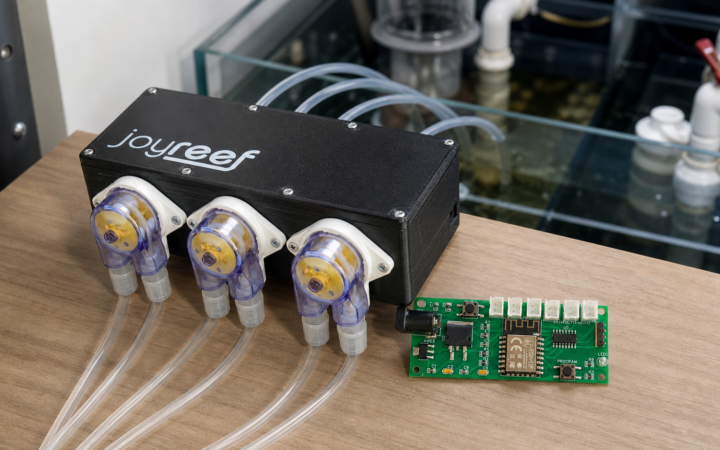
JoyReef started as a project to make DIY dosing accessible to everyone, but in 2026 it’s a good deal more than that.
JoyReef doser
| Model | Price | Channels | WiFi | Cloud | Notifications |
|---|---|---|---|---|---|
| Kamoer KXF kit | €120-210 | 1-6 | ✅ | ✅ | ✅ |
| Kamoer KFS PRO kit | €155-255 | 1-4 | ✅ | ✅ | ✅ |
| Mainboard only | €45 | up to 6 | (NodeMCU) | ✅ | ✅ |
What makes it different:
- ✅ Free cloud dashboard — no subscriptions
- ✅ Push notifications on your phone (power cuts, empty containers)
- ✅ Dosing history tracked in the portal
- ✅ Built-in blackout alarm
- ✅ Container level monitoring with a threshold you set
- ✅ Full guides — assembly in 15-20 minutes, no soldering
- ✅ Direct support from the person who designed the system
- ✅ 0.2ml precision, 40ml/min flow rate
JoyReef ATO controller — from €28
With a NodeMCU ESP8266 (€4-7), a DS18B20 sensor, an OLED display and four float switches you can build a complete ATO controller that monitors temperature and water level and drives Tasmota smart plugs — all over WiFi, with a cloud dashboard and notifications.
📊 Head to head
| Feature | Apex | GHL | Hydros | Red Sea | Reef-Pi | JoyReef |
|---|---|---|---|---|---|---|
| Entry price | $791.99 | €549.90 | $434.27 | $329.00 | ~$70 | ~€30 |
| Free cloud | ❌ | ❌ | ✅ | ✅ | ❌ | ✅ |
| Push notifications | ✅ | ✅ | ✅ | ✅ | ❌ | ✅ |
| DIY / customisable | ❌ | ❌ | ❌ | ❌ | ✅ | ✅ |
| Support | Dealers | Dealers | Dealers | Dealers | Community | ✅ Direct |
| No soldering | N/A | N/A | N/A | N/A | ❌ | ✅ |
| Expandable to full controller | ✅ | ✅ | ✅ | ✅ | ✅ | ✅ |
🤔 Which one should you pick?
- You have $1,000+ and want the best with no hassle → Neptune Apex
- You have $500-1,000 and prefer German engineering → GHL ProfiLux
- You already run a Red Sea tank and want one ecosystem → Red Sea ReefControl
- You’re a Linux tinkerer on a tight budget → Reef-Pi
- You want to save money but keep cloud and notifications → 🥇 JoyReef
- You want to build and learn without losing support → 🥇 JoyReef
- You have €30 for an ATO → 🥇 JoyReef controller
🎯 Bottom line
The professional controllers (Apex, GHL) are remarkable machines, but their cost puts them out of reach for most people. Red Sea arriving under $500 has made the middle of the market busier and more interesting. Reef-Pi is powerful but demands skills not everyone has.
JoyReef sits right in the middle: it gives you the control and the satisfaction of building it yourself, without leaving you stranded. The cloud portal is free, the guides are thorough, and support comes directly from the person who designed the system. You can start with €30 for the ATO or €120 for a complete doser.
That’s the difference: with JoyReef you’re not on your own.