
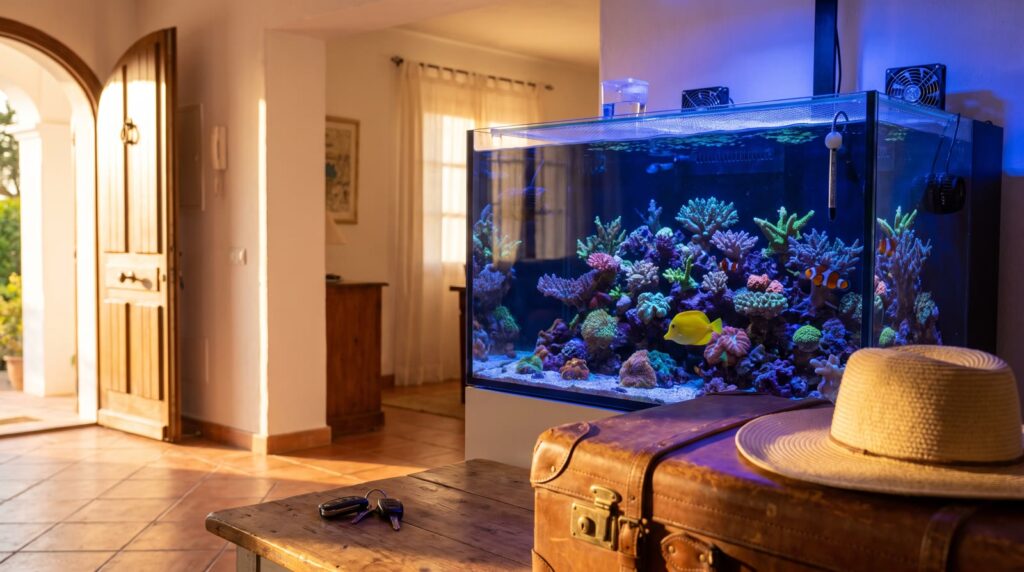
The holiday has been booked for months, the suitcase is half packed, and there it is again the night before: what about the tank? Anyone who keeps a reef tank knows the feeling. A freshwater aquarium will forgive two weeks on its own. A reef tank — with its evaporation, its corals and its narrow margins — is a different animal.
The good news is that you don’t have to give up your holiday, and you don’t have to spend a fortune either. You need to prepare the tank a few days in advance, automate the three or four things that genuinely can’t wait, and leave whoever stays behind instructions they can follow at a glance. Here’s how, in order of importance.
The question every reefer asks in July: “what about the tank?”
The cruel thing about August is that your tank hits its most delicate moment of the year exactly when you’re furthest away. Closed house, blinds down, over 35 °C outside and nobody opening a window: the environment around the aquarium behaves unlike any other time of year.
This isn’t about fear, it’s about odds. The things that go wrong while you’re away are almost always the same three, they’re well known, and two of them have a cheap, proven fix. The third — the genuine emergency, a dead return pump, a three-day power cut — isn’t solved by automation. It’s mitigated by a trusted human and by finding out early.
The three things that most often go wrong while you’re away
The water level dropping. This is the number one, and it does the most damage precisely because it’s slow and silent. In a marine tank only water evaporates — the salt stays behind, so every litre lost and not replaced raises the salinity of the whole system. In summer, with cooling fans running far more hours, evaporation can easily double. Two weeks without top-off on a tank losing five litres a day isn’t a low water level: it’s a salinity drift your corals will pay for.
Temperature climbing. With the house shut up, the afternoon peak lasts longer and the night cools less. If you have a temperature-controlled fan or a chiller, August is the month they actually earn their keep. If you don’t, August is the month you notice.
Feeding. The most overrated of the three. A healthy adult fish handles ten days on little food perfectly well, whereas excess food in a warm, closed-up tank produces nutrient spikes, algae and — in the worst cases — an oxygen crash. The holiday rule is blunt: too little beats too much.
The trouble is that these three compound. Heat drives evaporation, evaporation raises salinity, high salinity stresses corals already struggling with temperature, and meanwhile the uneaten food degrades the water. None of them is dramatic on its own. It’s the combination that does the harm.
Auto top-off: the single most important safeguard
If you only do one thing before you leave, do this one. An auto top-off (ATO) is a level sensor, a small pump and a reservoir of RO water: when the level in the sump drops, the pump brings it back. It costs very little, it goes together in an afternoon, and it removes the most serious problem of your two weeks away in one move.
The tricky part isn’t making it work — it’s making it fail well. An ATO that breaks with the pump running empties the whole reservoir into your tank, and at that point the cure is worse than the disease. That’s why a properly built top-off has more than one safeguard:
- A second, high-level sensor. Optional everywhere and recommended everywhere: it’s what stops the pump if the main sensor sticks in the low position.
- A maximum runtime per dose. If the pump runs past its expected maximum without the level recovering, something is wrong — empty reservoir, detached tube, seized impeller — and the right response is to stop, not to keep going.
- A daily total limit. This covers the case where many small bad doses add up over the course of a day.
- A trigger delay and a stop delay. The water surface always moves, and without a one or two second filter the float would switch the pump on and off constantly.
In JoyReef these safeguards live on the portal’s ATO page, alongside the low sensor, the optional high sensor and the smart plug driving the pump. When a safeguard trips, the pump stays locked and the portal tells you why in plain words — “dose ran too long”, “maximum level reached” — with a list of likely causes. Unlocking is deliberately manual: an ATO that restarts itself after a fault you haven’t understood is an ATO that will empty the reservoir a second time.
One piece of advice matters more than all the rest: test the ATO at least a week before you travel, not on packing night. Let it run several full cycles while you’re standing there watching. And size the RO reservoir against your August evaporation, not your April figure: if you lose five litres a day in summer and you’re away for two weeks, a 30-litre reservoir runs dry halfway through.
Feeding without you: the programmable feeder
An automatic feeder solves the food problem, as long as you use it with a light hand. Two practical points that apply to any model.
First: calibrate it days in advance. Flake and pellet foods have very different densities, and the same setting will deliver wildly different amounts; the only way to know is to run it onto a sheet of paper and look at what falls. Second: cut the portions to roughly half or two thirds of your normal amount, and spread them over several small feeds rather than one big one. In a closed-up house in August, uneaten food is the fastest route to bad water.
Watch out for humidity. In most feeder failures the culprit is food caking inside the hopper because of the vapour rising off the tank. A silica gel sachet in the compartment, if your model allows it, and positioning the feeder away from the fan’s airflow will solve it nearly every time.
In the portal the feeder has its own page, with scheduled feeds, the ability to trigger a manual feed remotely, and motor calibration. If you want reassurance from a beach chair that it’s still working, a manual feed on demand is the most direct way to check.
Dosing and maintenance: what to pause and what to leave alone
The rule here is simple: leave alone whatever is already stable and automatic; postpone whatever needs your hands.
Scheduled calcium, alkalinity and magnesium dosing — Balling, kalkwasser, trace elements — should stay exactly as it is. Changing it shortly before leaving is one of the classic mistakes: you shift a balance and then you’re not there to see the result. There’s only one thing worth checking: that the containers hold enough for the whole period, with margin.
Water changes, on the other hand, get moved forward: do one two or three days before you leave so you set off with the water in good shape. Postpone everything optional until you’re back — new fish or corals, moving rock, changing your fertilisation regime, deep-cleaning the skimmer. The fortnight before a holiday is not the time to change anything. A tank that leaves in balance stays that way far more easily than one you’ve just rearranged.
One check people routinely forget: restart behaviour after a power cut. If the power drops for a few hours while you’re away, the system should come back in an orderly sequence rather than all at once. It’s worth confirming that every smart plug knows which state to return to when the power comes back.
The human plan B: who checks the tank for you
No automation replaces a person opening the door and looking into the tank. If you have a neighbour, a friend or a relative available, that’s the most valuable thing you can arrange — even just a visit every three or four days.
Instructions make the difference. Assume nothing, and above all don’t ask for judgement calls: ask for binary checks, things you look at and answer yes or no. Leave a printed sheet next to the tank covering the water level in the RO reservoir, whether the fan is spinning, whether the glass has suddenly got much dirtier than usual, whether any fish has disappeared. Add your number, the number of a local aquarium shop and, if there is one, where the main breaker is.
The single most useful item is a photo of the tank taken on the day you leave: whoever checks it can compare it against what they see, and five words on the phone (“it looks like the photo”) beat half an hour of description.
This is where the digital side comes in, and it’s worth being honest about what it does and doesn’t do. A portal like JoyReef repairs nothing remotely: it shows you temperature, levels and the state of your plugs, and it sends a notification to your phone when something leaves the range you set or when an ATO safeguard trips. It isn’t a promise that nothing will happen — it’s knowing while you’re away, instead of finding out when you get back. And that’s exactly what lets you call your neighbour with a specific request rather than a vague worry.
Before you lock the door: the departure checklist
- One week out: test the ATO through real cycles while you watch; calibrate the feeder with the food you’ll actually use.
- Three days out: water change; check your main parameters; confirm the dosing containers will last the whole period.
- Two days out: clean the glass and the skimmer; replace any filter media that would expire while you’re away.
- The day before: fill the RO reservoir to the top; check the floats move freely and are clean; test the notifications on your phone and confirm they actually arrive.
- Departure day: photo of the tank; instruction sheet beside the aquarium; keys and numbers to whoever is visiting; a last look at plugs and cables.
None of this needs expensive equipment. It needs to be done a few days ahead instead of in a rush — and that, far more than budget, is the difference between coming home to a tank in good order and coming home to a nasty surprise.
One last thing worth repeating: automation helps you notice sooner and intervene less often, but hardware failsafes — the high-level sensor, the RCD, the safety thermostat — remain essential, and the reefer’s own eye is still the best sensor you own. Even in August, even five hundred kilometres away.
Start the free beta before you travel and try the notifications while you still have time 👉 portal.joy-reef.com/beta — and if you’re unsure how to prepare the tank, ask the community on Discord: in late July it’s the most discussed topic there.