In summer, with outside temperatures easily climbing past 30-35°C (86-95°F), the reef tank becomes one of the most delicate spots in the house. Anyone who keeps a reef tank knows it well: it only takes a few extra degrees, for a few days, to put corals and fish that are perfectly fine under normal conditions under real stress.
Why summer is the toughest season for a reef tank
A reef tank is a closed system in a delicate balance, and heat challenges it on several fronts at once. Warm water holds less dissolved oxygen, right when the oxygen demand of fish and corals goes up. Evaporation speeds up, and salinity climbs with it if top-off doesn’t keep pace. Lighting and pumps add their own heat to the water, on top of whatever comes from the room. None of these factors is dramatic on its own — the problem is that in summer they all act together, for days in a row.
How hot is too hot?
Most reef corals and fish do fine across a fairly wide range, typically between 24 and 27°C (75-81°F). Crossing 28-29°C (82-84°F) isn’t automatically a disaster, but it’s a sign the safety margin is shrinking: past those thresholds, the more sensitive SPS corals start showing signs of stress, and the risk of bleaching grows with how intense and how long the exposure is.
The rate of change matters just as much as the absolute number: a tank that gradually climbs one degree over a full day is a very different situation from one that gains two degrees in a few hours because a fan stopped or the AC was off for an afternoon. There’s no need to chase half a degree with anxiety — what matters is knowing your own tank’s trend, not just the instant reading on the thermometer.
Cooling fans: the simplest, cheapest defense
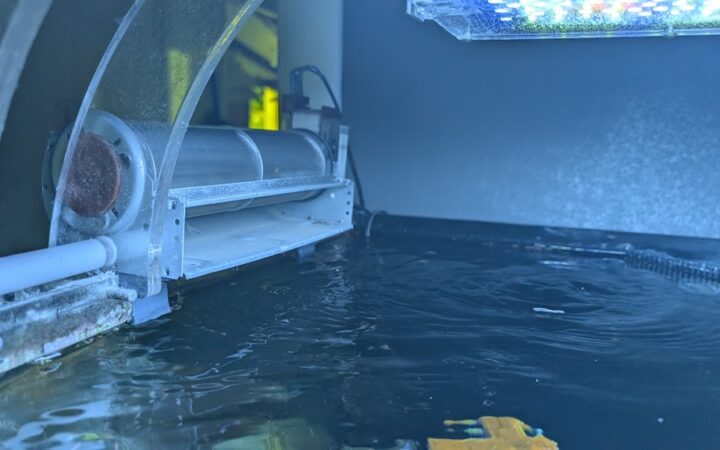
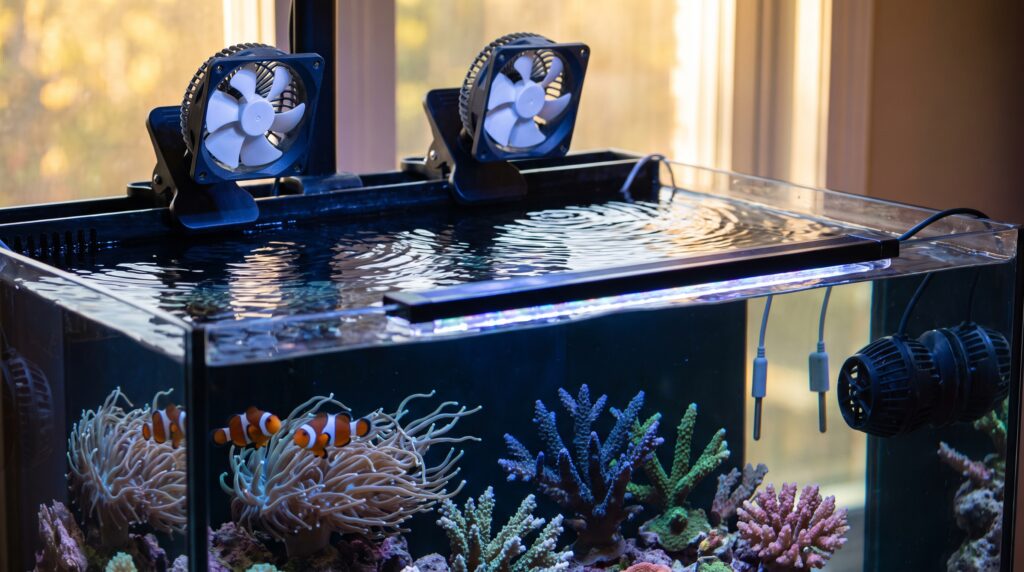
Before reaching for a chiller, most reef keepers solve — or at least ease — the problem with one or two fans clipped to the tank rim, blowing across the water surface. The principle is evaporative cooling: moving air speeds up surface evaporation, and evaporation pulls heat out of the water.
Realistically, two well-placed fans can bring the temperature down by one or two degrees compared to the same tank with still air in the same room. That’s not a chiller, but for plenty of home tanks it’s enough to stay inside a safe range through the hottest months, for a cost of just a few euros per fan.
The price of cooling: evaporation and salinity
Evaporative cooling has a side cost: the more air you move across the surface, the more water evaporates, and the more salinity climbs if you don’t compensate for it. That’s why, in peak summer, an auto top-off (ATO) system stops being a nice-to-have and becomes close to essential — without one, the real risk is that fans solve the temperature problem and create a new one on salinity, possibly while you’re at work or on holiday.
Chillers, air conditioning, ice: the other options compared
When fans aren’t enough, or the tank is particularly large or exposed, the known alternatives are:
- A dedicated chiller — the most effective and predictable solution, but also the most expensive (often several hundred euros) and with a continuous power draw to factor in. It makes sense for large tanks or rooms that reliably go past 30°C indoors in summer.
- Room air conditioning — often already in the house: it cools the room and, as a side effect, the tank — with the bonus of also benefiting the people in the room, not just the fish. The downside is depending on a system that’s already running at capacity in summer for other reasons.
- Ice bottles in the tank or sump — an emergency fix, useful during an isolated heat wave or an extended power outage, but one to handle carefully: too rapid a temperature swing is itself a stressor for tank inhabitants.
Often the most sensible combination is also the simplest: fans as the first line of defense year-round, with a chiller or AC as backup for the hardest peaks.
The real enemy: not noticing in time
The real risk is almost never a single extreme reading — it’s the time that passes before anyone notices. You get home from work, check the display, and the tank has climbed two degrees since morning: the fan stopped, the AC was off, or it was simply a hotter day than expected. The damage isn’t done by the heat itself, but by the hours nobody noticed.
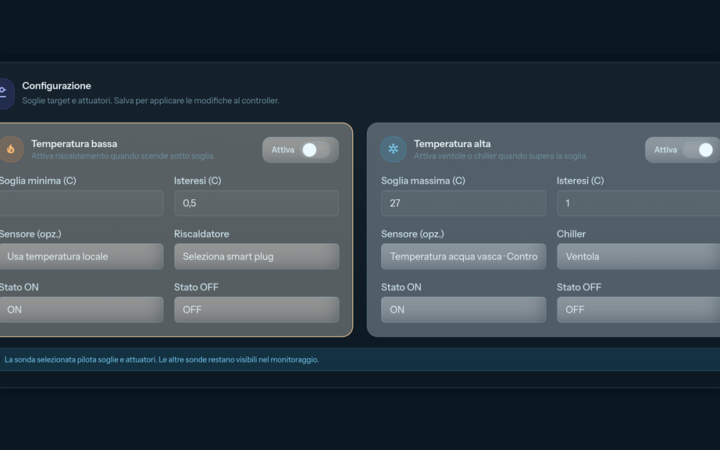
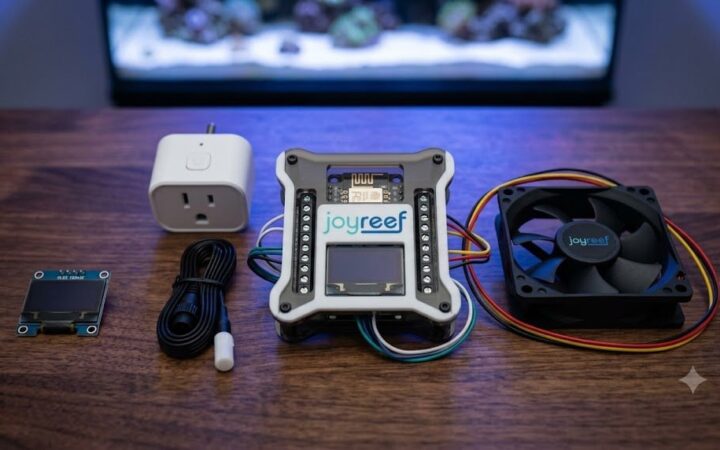
This is where JoyReef comes in: temperature thresholds you set once, rules that turn on fans or plugs when needed, a history that shows the tank’s actual trend rather than just the last reading, and a notification on your phone if the temperature drifts outside the range you chose. It’s not a promise that nothing will ever go wrong again — it’s the chance to notice sooner, while there’s still time to act.
Summer blackouts: air conditioners and storms
Summer brings another specific risk: sudden storms and a power grid under strain from millions of air conditioners running at once, which means more frequent blackouts than in other seasons. As with heat, the critical moment isn’t the outage itself but power coming back: heater, pumps and skimmer all restart together, and a skimmer restarting with a full sump can flood a cabinet within minutes.
Tasmota smart plugs connected to JoyReef let you decide in advance how each outlet behaves when power returns — what restarts right away, what waits a few minutes, what stays off until you check it yourself — and to get a notification if a device shows up offline. Hardware failsafes (mechanical floats, check valves, pump protections) remain the first line of defense either way: automation adds a layer, it doesn’t replace them.
The ready-to-use summer checklist
- Evaporation fans clean and correctly positioned on the tank rim
- Auto top-off (ATO) system checked, with enough reserve water on hand
- Temperature thresholds set, with a realistic margin before the alert fires
- Smart plugs configured for a safe restart after a power outage
- One eye on the weather forecast for the hottest days, one on your tank’s data history
None of these measures alone is a magic fix — the tank still needs your own eyes on it, every day. But with the right habits and a bit of help noticing sooner when something changes, summer becomes just another month, not a month of anxiety.
Try the free JoyReef beta and set your temperature thresholds before the next heat wave 👉 portal.joy-reef.com/beta